Martin Bell11 Min Read
How to Build a Founder Operating System (2026)
A 2026 operating-system guide for keeping startup context, priorities, learning loops, and weekly execution in one place.
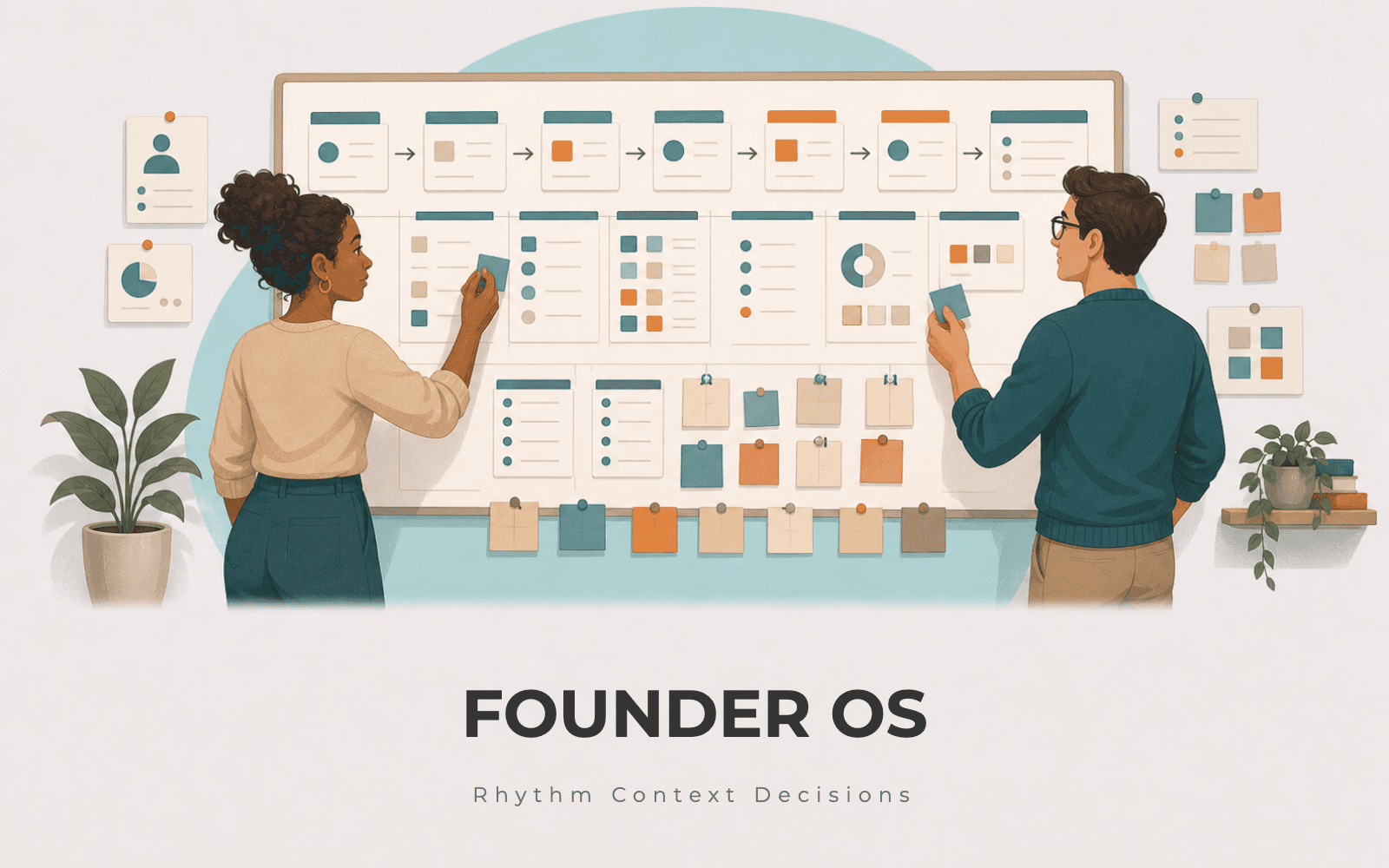
A founder operating system is the way a company turns context into decisions and decisions into completed work. It does not need to be complicated. It needs to keep the founder from losing the thread.
In 2026, AI makes output faster, which increases the cost of poor operating discipline. A founder can generate documents, code, content, and research quickly, but without a system those outputs become noise.
This guide shows how to build a practical founder operating system around goals, tasks, customer learning, decisions, metrics, and weekly rhythm.
Key Takeaways
-
A founder operating system is a rhythm, not a tool stack.
-
Keep customer learning, tasks, decisions, and metrics connected.
-
Use weekly review to turn learning into next actions.
-
AI is most useful when it has company context and clear task boundaries.
-
Avoid overbuilding operations before the business has real signals.
The Founder OS Components
A useful founder operating system has six components: direction, task board, customer learning, decision log, metrics, and review rhythm. Each component should answer a practical question.
Direction asks what matters now. Tasks ask what gets done next. Customer learning asks what the market taught you. Decisions ask what changed. Metrics ask what is true. Review rhythm asks how the next week should adapt.
The system should be light enough to use every week and structured enough that AI can help without starting from a blank chat every time.
Set the Current Direction
The founder needs one active stage and a few priorities, not a giant plan that treats every task as equal.
This section is a gate, not a decoration. If the founder cannot complete it in plain language, the idea is probably still too vague for product, marketing, or fundraising work. Slow down here and turn the point into an artifact the company can reuse: a note, checklist, customer definition, scorecard, outreach list, weekly review prompt, or decision memo.
The practical move: Write the current company stage, main objective, top constraints, and three priorities for the next month. Make it concrete enough that someone else could inspect the work and understand what changed. If AI helps draft, summarize, or compare options, use it as a speed layer, then review the output against customer facts and founder judgment.
The signal to watch: You can say no to work that does not support the current objective.
When that signal appears, write down what it means for the next task. The point is not to collect a nice insight. The point is to decide whether to continue, narrow, change, sell, build, or stop.
Avoid keeping every possible initiative alive at the same time.. The common failure mode is treating this as a planning exercise instead of a market-facing loop. Every section should make the next customer conversation, offer, MVP, or operating decision sharper.
Create a Task Board That Reflects Reality
A task board is useful when it shows actual work, owners, status, and definition of done.
This section is a gate, not a decoration. If the founder cannot complete it in plain language, the idea is probably still too vague for product, marketing, or fundraising work. Slow down here and turn the point into an artifact the company can reuse: a note, checklist, customer definition, scorecard, outreach list, weekly review prompt, or decision memo.
The practical move: Use columns such as backlog, next, doing, blocked, review, and done. Add acceptance criteria for important tasks. Make it concrete enough that someone else could inspect the work and understand what changed. If AI helps draft, summarize, or compare options, use it as a speed layer, then review the output against customer facts and founder judgment.
The signal to watch: The board helps you choose the next task without rethinking the whole company.
When that signal appears, write down what it means for the next task. The point is not to collect a nice insight. The point is to decide whether to continue, narrow, change, sell, build, or stop.
Avoid turning the board into a dumping ground for ideas.. The common failure mode is treating this as a planning exercise instead of a market-facing loop. Every section should make the next customer conversation, offer, MVP, or operating decision sharper.
Keep Customer Learning in One Place
Customer conversations lose value when insights are scattered across notes, transcripts, and memory.
This section is a gate, not a decoration. If the founder cannot complete it in plain language, the idea is probably still too vague for product, marketing, or fundraising work. Slow down here and turn the point into an artifact the company can reuse: a note, checklist, customer definition, scorecard, outreach list, weekly review prompt, or decision memo.
The practical move: Store interview notes, objections, quotes, feature requests, churn reasons, and sales patterns in a searchable format. Make it concrete enough that someone else could inspect the work and understand what changed. If AI helps draft, summarize, or compare options, use it as a speed layer, then review the output against customer facts and founder judgment.
The signal to watch: Product, marketing, and sales work can cite real customer language.
When that signal appears, write down what it means for the next task. The point is not to collect a nice insight. The point is to decide whether to continue, narrow, change, sell, build, or stop.
Avoid summarizing everything so aggressively that the customer's words disappear.. The common failure mode is treating this as a planning exercise instead of a market-facing loop. Every section should make the next customer conversation, offer, MVP, or operating decision sharper.
Write Decisions Down
A startup changes quickly. Without a decision record, the founder revisits the same questions repeatedly.
This section is a gate, not a decoration. If the founder cannot complete it in plain language, the idea is probably still too vague for product, marketing, or fundraising work. Slow down here and turn the point into an artifact the company can reuse: a note, checklist, customer definition, scorecard, outreach list, weekly review prompt, or decision memo.
The practical move: For meaningful decisions, record the date, context, options, decision, reason, and revisit trigger. Make it concrete enough that someone else could inspect the work and understand what changed. If AI helps draft, summarize, or compare options, use it as a speed layer, then review the output against customer facts and founder judgment.
The signal to watch: You can explain why the company is doing something and when that reason should be challenged.
When that signal appears, write down what it means for the next task. The point is not to collect a nice insight. The point is to decide whether to continue, narrow, change, sell, build, or stop.
Avoid creating a museum of notes nobody reads.. The common failure mode is treating this as a planning exercise instead of a market-facing loop. Every section should make the next customer conversation, offer, MVP, or operating decision sharper.
Choose a Small Metrics Set
Metrics should reveal whether the current strategy is working. Too many numbers create fog.
This section is a gate, not a decoration. If the founder cannot complete it in plain language, the idea is probably still too vague for product, marketing, or fundraising work. Slow down here and turn the point into an artifact the company can reuse: a note, checklist, customer definition, scorecard, outreach list, weekly review prompt, or decision memo.
The practical move: Track a few metrics tied to the current stage: interviews, qualified leads, activation, revenue, retention, runway, or delivery quality. Make it concrete enough that someone else could inspect the work and understand what changed. If AI helps draft, summarize, or compare options, use it as a speed layer, then review the output against customer facts and founder judgment.
The signal to watch: Each metric connects to a decision you might make.
When that signal appears, write down what it means for the next task. The point is not to collect a nice insight. The point is to decide whether to continue, narrow, change, sell, build, or stop.
Avoid tracking vanity numbers because they look good in a dashboard.. The common failure mode is treating this as a planning exercise instead of a market-facing loop. Every section should make the next customer conversation, offer, MVP, or operating decision sharper.
Build the Weekly Review
The weekly review is where the operating system becomes real.
This section is a gate, not a decoration. If the founder cannot complete it in plain language, the idea is probably still too vague for product, marketing, or fundraising work. Slow down here and turn the point into an artifact the company can reuse: a note, checklist, customer definition, scorecard, outreach list, weekly review prompt, or decision memo.
The practical move: Review customer learning, metrics, completed tasks, blocked work, decisions, and the next three priorities. Make it concrete enough that someone else could inspect the work and understand what changed. If AI helps draft, summarize, or compare options, use it as a speed layer, then review the output against customer facts and founder judgment.
The signal to watch: The next week changes based on evidence from the last week.
When that signal appears, write down what it means for the next task. The point is not to collect a nice insight. The point is to decide whether to continue, narrow, change, sell, build, or stop.
Avoid reviewing status without deciding what to do differently.. The common failure mode is treating this as a planning exercise instead of a market-facing loop. Every section should make the next customer conversation, offer, MVP, or operating decision sharper.
Use AI With Company Context
AI is strongest when it knows the company, customer, product, brand, and current task.
This section is a gate, not a decoration. If the founder cannot complete it in plain language, the idea is probably still too vague for product, marketing, or fundraising work. Slow down here and turn the point into an artifact the company can reuse: a note, checklist, customer definition, scorecard, outreach list, weekly review prompt, or decision memo.
The practical move: Give AI the relevant context, task objective, constraints, source material, and quality bar before asking for output. Make it concrete enough that someone else could inspect the work and understand what changed. If AI helps draft, summarize, or compare options, use it as a speed layer, then review the output against customer facts and founder judgment.
The signal to watch: AI work becomes easier to review and more connected to the business.
When that signal appears, write down what it means for the next task. The point is not to collect a nice insight. The point is to decide whether to continue, narrow, change, sell, build, or stop.
Avoid blank-chat prompting that ignores decisions already made.. The common failure mode is treating this as a planning exercise instead of a market-facing loop. Every section should make the next customer conversation, offer, MVP, or operating decision sharper.
Keep the System Lightweight
The operating system should help the founder execute, not become a second company to maintain.
This section is a gate, not a decoration. If the founder cannot complete it in plain language, the idea is probably still too vague for product, marketing, or fundraising work. Slow down here and turn the point into an artifact the company can reuse: a note, checklist, customer definition, scorecard, outreach list, weekly review prompt, or decision memo.
The practical move: Remove fields, views, and rituals that do not improve decisions or follow-through. Make it concrete enough that someone else could inspect the work and understand what changed. If AI helps draft, summarize, or compare options, use it as a speed layer, then review the output against customer facts and founder judgment.
The signal to watch: You keep using the system when the week gets busy.
When that signal appears, write down what it means for the next task. The point is not to collect a nice insight. The point is to decide whether to continue, narrow, change, sell, build, or stop.
Avoid copying enterprise operating rituals before the startup needs them.. The common failure mode is treating this as a planning exercise instead of a market-facing loop. Every section should make the next customer conversation, offer, MVP, or operating decision sharper.
A Founder OS Should Make the Next Task Obvious
The best operating system is not the most elaborate. It is the one that preserves context and makes the next task easier to choose and complete.
In a 2026 startup, speed without context creates noise. Context without execution creates documents. The founder operating system connects both.
That is the core of 100 Tasks AI: a proven process, company context, AI execution, and a rhythm that helps founders keep moving from idea to scale.

Martin Bell
Startup-building guidance from the 100 Tasks framework.