Martin Bell11 Min Read
10 Business Pitch Examples for New Founders (2026)
A 2026 example library for matching the pitch structure to the audience, decision, proof, and next ask.
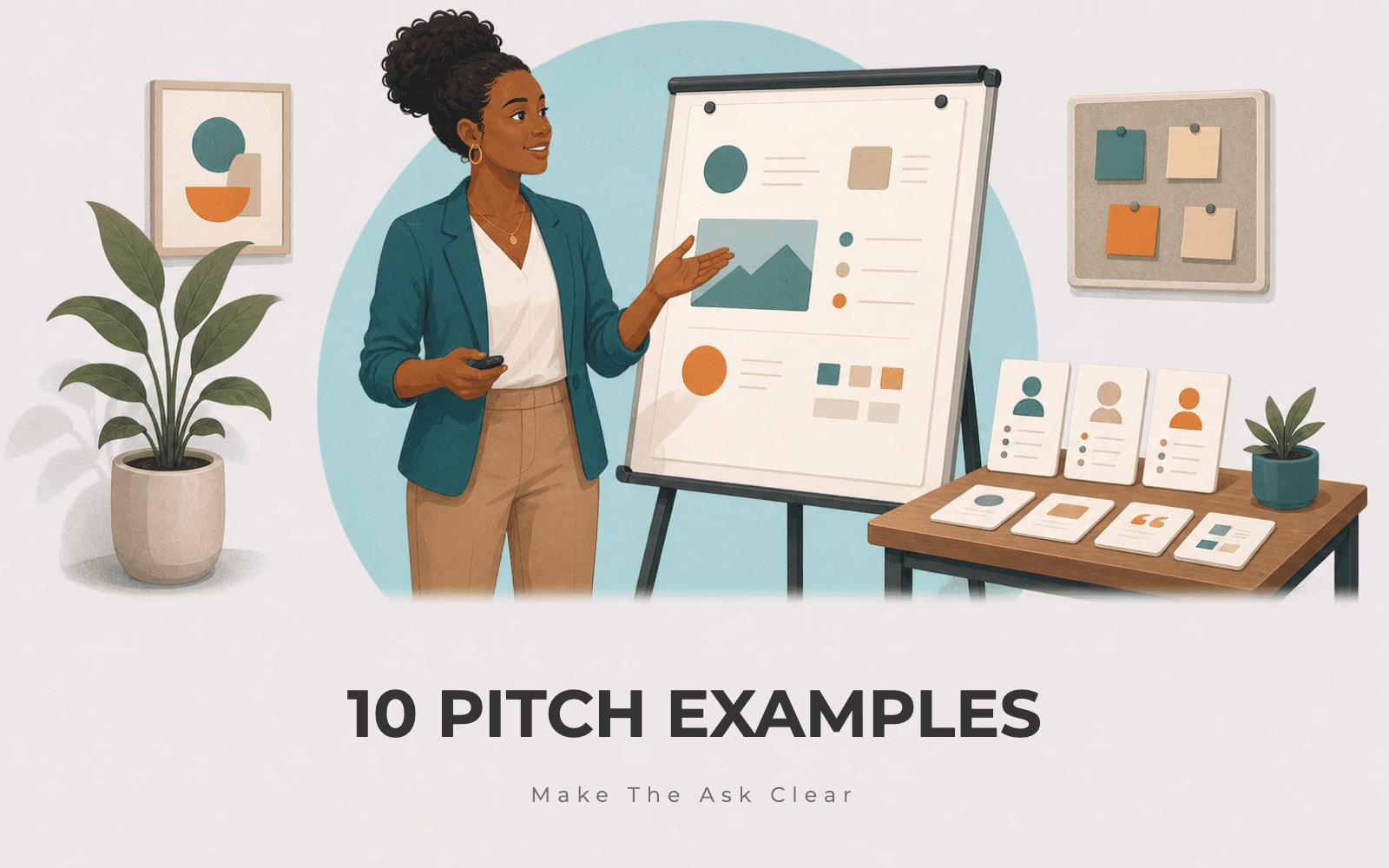
A good business pitch is not one script used everywhere. A customer pitch, investor pitch, partnership pitch, pilot pitch, and recruiting pitch all need different proof and a different ask.
New founders often over-explain the product because they are trying to sound credible. The stronger move is to match the pitch to the decision the listener needs to make.
The examples below show how to frame the problem, proof, and next step for common founder situations in 2026.
Key Takeaways
-
A pitch should make one decision easier for one audience.
-
Start with the problem and why now, then show the specific proof that audience needs.
-
The ask must be explicit: buy, pilot, invest, partner, refer, join, or advise.
-
Different audiences need different evidence.
-
Avoid making every pitch sound like an investor deck.
The Simple Pitch Structure
Use this base: audience, painful problem, why current options fail, your approach, proof, specific ask, and next step. The order can change, but the ingredients rarely disappear.
Then adapt the proof. Customers need outcome proof. Investors need market, traction, and founder insight. Partners need mutual value. Employees need mission, role clarity, and trust. Grant reviewers need eligibility and impact.
A pitch is successful when the listener knows exactly what you want them to do next.
1. Customer Pain Pitch
This idea serves a buyer who knows the problem but has not chosen a solution. The promise is to show that you understand the painful workflow and can create a clear result. That matters because the customer is not buying an abstract tool or a clever business model. They are buying a cleaner version of a painful job they already recognize.
The first version should stay deliberately small: lead with the customer's recent problem, current workaround, and the outcome your offer delivers. Use AI where it helps with research, drafting, sorting, or summarizing, but keep human judgment in the final delivery. Early customers are paying for a useful result, not for unreviewed output.
The validation signal is that the buyer asks about fit, timing, price, or implementation. If that signal appears more than once, you can improve the package, write the delivery checklist, and decide whether the offer should become a productized service, template, or software wedge.
Avoid starting with your company story before the buyer sees themselves. That mistake makes the business look larger while making the actual learning weaker.
2. Before-and-After Pitch
This idea serves a buyer who needs to visualize the value quickly. The promise is to compare the current messy state with the improved state after your solution. That matters because the customer is not buying an abstract tool or a clever business model. They are buying a cleaner version of a painful job they already recognize.
The first version should stay deliberately small: show the before, explain the cost, then show the after and the path to get there. Use AI where it helps with research, drafting, sorting, or summarizing, but keep human judgment in the final delivery. Early customers are paying for a useful result, not for unreviewed output.
The validation signal is that the buyer points to the before state and says that is us. If that signal appears more than once, you can improve the package, write the delivery checklist, and decide whether the offer should become a productized service, template, or software wedge.
Avoid making the after state so perfect it feels unbelievable. That mistake makes the business look larger while making the actual learning weaker.
3. Wedge Pitch
This idea serves investors or strategic partners evaluating a focused entry point. The promise is to explain the narrow first market and why it can expand. That matters because the customer is not buying an abstract tool or a clever business model. They are buying a cleaner version of a painful job they already recognize.
The first version should stay deliberately small: describe the first customer segment, urgent problem, proof, and adjacent expansion path. Use AI where it helps with research, drafting, sorting, or summarizing, but keep human judgment in the final delivery. Early customers are paying for a useful result, not for unreviewed output.
The validation signal is that the listener understands why the small start is strategically smart. If that signal appears more than once, you can improve the package, write the delivery checklist, and decide whether the offer should become a productized service, template, or software wedge.
Avoid pitching a giant market with no credible first wedge. That mistake makes the business look larger while making the actual learning weaker.
4. Paid Pilot Pitch
This idea serves a business buyer willing to test but not ready for a full commitment. The promise is to make a limited pilot feel low-risk and decision-ready. That matters because the customer is not buying an abstract tool or a clever business model. They are buying a cleaner version of a painful job they already recognize.
The first version should stay deliberately small: define scope, timeline, success metric, price, owner, and what happens after the pilot. Use AI where it helps with research, drafting, sorting, or summarizing, but keep human judgment in the final delivery. Early customers are paying for a useful result, not for unreviewed output.
The validation signal is that the buyer agrees to the pilot terms or negotiates real constraints. If that signal appears more than once, you can improve the package, write the delivery checklist, and decide whether the offer should become a productized service, template, or software wedge.
Avoid free pilots with no success metric or next decision. That mistake makes the business look larger while making the actual learning weaker.
5. Investor Narrative Pitch
This idea serves angels, pre-seed investors, or advisors evaluating venture potential. The promise is to connect market shift, customer pain, traction, team insight, and fundraising ask. That matters because the customer is not buying an abstract tool or a clever business model. They are buying a cleaner version of a painful job they already recognize.
The first version should stay deliberately small: explain why now, why this customer, why this product, why this team, and what the round proves. Use AI where it helps with research, drafting, sorting, or summarizing, but keep human judgment in the final delivery. Early customers are paying for a useful result, not for unreviewed output.
The validation signal is that investors ask deeper questions about traction, market, and use of funds. If that signal appears more than once, you can improve the package, write the delivery checklist, and decide whether the offer should become a productized service, template, or software wedge.
Avoid leading with product features before investor-level context is clear. That mistake makes the business look larger while making the actual learning weaker.
6. Partnership Pitch
This idea serves a company or creator with access to your target audience. The promise is to show why working together creates value for both sides. That matters because the customer is not buying an abstract tool or a clever business model. They are buying a cleaner version of a painful job they already recognize.
The first version should stay deliberately small: name the shared audience, the partner benefit, the customer benefit, and the smallest collaboration. Use AI where it helps with research, drafting, sorting, or summarizing, but keep human judgment in the final delivery. Early customers are paying for a useful result, not for unreviewed output.
The validation signal is that the partner suggests a channel, format, or pilot collaboration. If that signal appears more than once, you can improve the package, write the delivery checklist, and decide whether the offer should become a productized service, template, or software wedge.
Avoid asking for distribution without giving the partner a reason to care. That mistake makes the business look larger while making the actual learning weaker.
7. Enterprise ROI Pitch
This idea serves a larger buyer who needs economic justification and risk control. The promise is to connect the product to cost, speed, revenue, compliance, or risk reduction. That matters because the customer is not buying an abstract tool or a clever business model. They are buying a cleaner version of a painful job they already recognize.
The first version should stay deliberately small: show baseline, expected improvement, implementation path, owner, and measurement plan. Use AI where it helps with research, drafting, sorting, or summarizing, but keep human judgment in the final delivery. Early customers are paying for a useful result, not for unreviewed output.
The validation signal is that the buyer brings in stakeholders rather than only praising the idea. If that signal appears more than once, you can improve the package, write the delivery checklist, and decide whether the offer should become a productized service, template, or software wedge.
Avoid using inflated ROI math that cannot survive procurement. That mistake makes the business look larger while making the actual learning weaker.
8. Product Demo Pitch
This idea serves a buyer who needs to see how the product works in their workflow. The promise is to demonstrate the core behavior with their situation, not a generic tour. That matters because the customer is not buying an abstract tool or a clever business model. They are buying a cleaner version of a painful job they already recognize.
The first version should stay deliberately small: start with the user's job, show the smallest path to value, then ask what would block adoption. Use AI where it helps with research, drafting, sorting, or summarizing, but keep human judgment in the final delivery. Early customers are paying for a useful result, not for unreviewed output.
The validation signal is that the buyer discusses real usage, setup, data, and team behavior. If that signal appears more than once, you can improve the package, write the delivery checklist, and decide whether the offer should become a productized service, template, or software wedge.
Avoid showing every feature because you are proud of the build. That mistake makes the business look larger while making the actual learning weaker.
9. Recruiting Pitch
This idea serves a potential early hire, contractor, or cofounder. The promise is to explain why the company matters, what is true now, and what role the person would play. That matters because the customer is not buying an abstract tool or a clever business model. They are buying a cleaner version of a painful job they already recognize.
The first version should stay deliberately small: share the customer problem, traction, constraints, role scope, and why their contribution matters. Use AI where it helps with research, drafting, sorting, or summarizing, but keep human judgment in the final delivery. Early customers are paying for a useful result, not for unreviewed output.
The validation signal is that the candidate asks serious questions about risk, ownership, and priorities. If that signal appears more than once, you can improve the package, write the delivery checklist, and decide whether the offer should become a productized service, template, or software wedge.
Avoid selling hype while hiding uncertainty. That mistake makes the business look larger while making the actual learning weaker.
10. Grant or Program Pitch
This idea serves grant reviewers, accelerators, or ecosystem programs. The promise is to show fit with the program's criteria, impact, feasibility, and next milestone. That matters because the customer is not buying an abstract tool or a clever business model. They are buying a cleaner version of a painful job they already recognize.
The first version should stay deliberately small: map the problem, beneficiary, solution, evidence, budget, and measurable outcome to the criteria. Use AI where it helps with research, drafting, sorting, or summarizing, but keep human judgment in the final delivery. Early customers are paying for a useful result, not for unreviewed output.
The validation signal is that the application reads like a focused project, not a generic startup description. If that signal appears more than once, you can improve the package, write the delivery checklist, and decide whether the offer should become a productized service, template, or software wedge.
Avoid copying investor language into a grant context where impact and eligibility matter more. That mistake makes the business look larger while making the actual learning weaker.
The Best Pitch Creates a Next Step
A pitch is not a performance. It is a tool for moving a decision forward.
Before you pitch, write the audience, decision, proof, and ask at the top of the page. Then cut anything that does not support those four things.
For new founders, this is the discipline: one audience, one decision, one clear next step. That is how a pitch becomes useful instead of impressive but vague.

Martin Bell
Startup-building guidance from the 100 Tasks framework.