Martin Bell11 Min Read
How to Turn a Service Business Into Software (2026)
A 2026 guide to turning repeated service delivery into software only after the workflow, buyer, and value are proven.
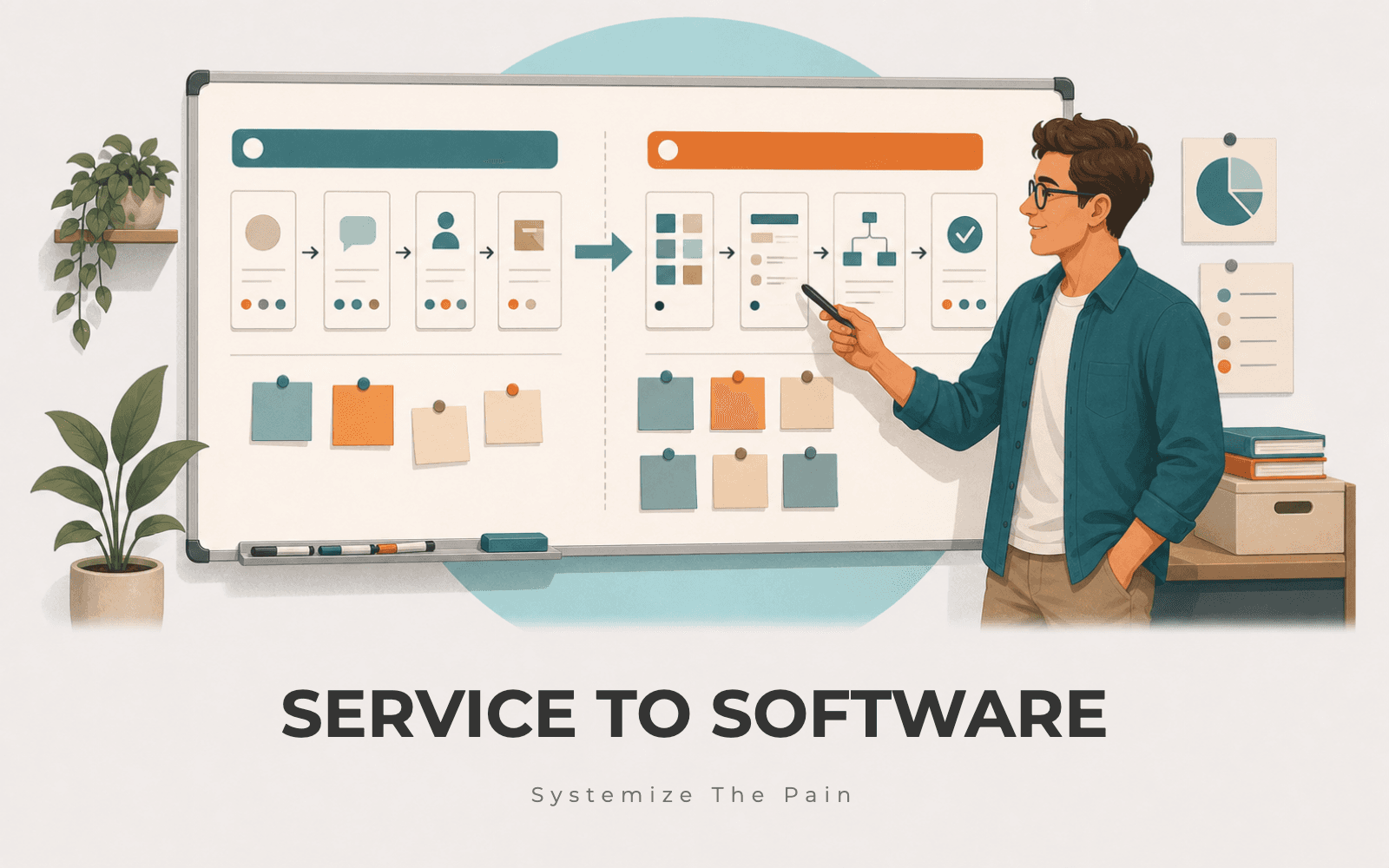
A service business can become software when the same customer, problem, workflow, and desired outcome repeat often enough that a product can deliver part of the value without custom human effort.
That sounds simple, but many founders automate too early. They turn a flexible service into rigid software before they know which steps customers value, which exceptions matter, and which human judgment creates trust.
This guide shows how to use the service as the learning engine, then build software only where the evidence supports it.
Key Takeaways
-
A service is a research lab when delivery repeats.
-
Do not automate custom judgment before you understand it.
-
Look for repeated inputs, decisions, outputs, and handoffs.
-
Build a narrow product wedge before rebuilding the entire service.
-
Keep service revenue and product learning connected.
The Service-to-Software Test
Before building, answer three questions. Do customers buy the same outcome repeatedly? Do the delivery steps repeat across customers? Would software make the result faster, cheaper, clearer, or more accessible without destroying trust?
If the answer is yes, choose one product wedge. The wedge might be intake, scoring, reminders, reporting, templates, collaboration, or a customer portal. It should make one part of the workflow obviously better.
If the answer is no, keep productizing the service. Better scope and repeatability usually come before software.
Map the Service Workflow
You cannot productize what you have not mapped. The map shows which steps are repeated and which are custom.
This section is a gate, not a decoration. If the founder cannot complete it in plain language, the idea is probably still too vague for product, marketing, or fundraising work. Slow down here and turn the point into an artifact the company can reuse: a note, checklist, customer definition, scorecard, outreach list, weekly review prompt, or decision memo.
The practical move: Document intake, analysis, decisions, customer review, delivery, follow-up, and reporting across recent clients. Make it concrete enough that someone else could inspect the work and understand what changed. If AI helps draft, summarize, or compare options, use it as a speed layer, then review the output against customer facts and founder judgment.
The signal to watch: You can identify repeated steps that appear in most projects.
When that signal appears, write down what it means for the next task. The point is not to collect a nice insight. The point is to decide whether to continue, narrow, change, sell, build, or stop.
Avoid building from memory instead of real delivery evidence.. The common failure mode is treating this as a planning exercise instead of a market-facing loop. Every section should make the next customer conversation, offer, MVP, or operating decision sharper.
Separate Judgment From Labor
Some service work is valuable because it requires expert judgment. Other work is valuable but repetitive.
This section is a gate, not a decoration. If the founder cannot complete it in plain language, the idea is probably still too vague for product, marketing, or fundraising work. Slow down here and turn the point into an artifact the company can reuse: a note, checklist, customer definition, scorecard, outreach list, weekly review prompt, or decision memo.
The practical move: Label each step as customer input, repeatable labor, expert judgment, approval, or exception handling. Make it concrete enough that someone else could inspect the work and understand what changed. If AI helps draft, summarize, or compare options, use it as a speed layer, then review the output against customer facts and founder judgment.
The signal to watch: You know which steps software can support and which steps should remain human-reviewed.
When that signal appears, write down what it means for the next task. The point is not to collect a nice insight. The point is to decide whether to continue, narrow, change, sell, build, or stop.
Avoid automating the part customers trusted you to think through.. The common failure mode is treating this as a planning exercise instead of a market-facing loop. Every section should make the next customer conversation, offer, MVP, or operating decision sharper.
Find the Repeated Customer Input
Software needs structured input. If every customer provides different information in a different way, the product will struggle.
This section is a gate, not a decoration. If the founder cannot complete it in plain language, the idea is probably still too vague for product, marketing, or fundraising work. Slow down here and turn the point into an artifact the company can reuse: a note, checklist, customer definition, scorecard, outreach list, weekly review prompt, or decision memo.
The practical move: Create an intake form or checklist and test whether customers can complete it without a long call. Make it concrete enough that someone else could inspect the work and understand what changed. If AI helps draft, summarize, or compare options, use it as a speed layer, then review the output against customer facts and founder judgment.
The signal to watch: Most customers can provide the required inputs with minimal clarification.
When that signal appears, write down what it means for the next task. The point is not to collect a nice insight. The point is to decide whether to continue, narrow, change, sell, build, or stop.
Avoid designing a product that depends on messy custom onboarding.. The common failure mode is treating this as a planning exercise instead of a market-facing loop. Every section should make the next customer conversation, offer, MVP, or operating decision sharper.
Identify the First Product Wedge
The first software version should improve one high-friction step, not replace the whole service.
This section is a gate, not a decoration. If the founder cannot complete it in plain language, the idea is probably still too vague for product, marketing, or fundraising work. Slow down here and turn the point into an artifact the company can reuse: a note, checklist, customer definition, scorecard, outreach list, weekly review prompt, or decision memo.
The practical move: Choose a wedge such as intake, reminders, reporting, recommendations, document generation, or status visibility. Make it concrete enough that someone else could inspect the work and understand what changed. If AI helps draft, summarize, or compare options, use it as a speed layer, then review the output against customer facts and founder judgment.
The signal to watch: Customers would use the wedge even if the rest of the service stayed manual.
When that signal appears, write down what it means for the next task. The point is not to collect a nice insight. The point is to decide whether to continue, narrow, change, sell, build, or stop.
Avoid building a full platform because the service has many steps.. The common failure mode is treating this as a planning exercise instead of a market-facing loop. Every section should make the next customer conversation, offer, MVP, or operating decision sharper.
Validate With Existing Customers
Service customers are the best test group because they already understand the pain.
This section is a gate, not a decoration. If the founder cannot complete it in plain language, the idea is probably still too vague for product, marketing, or fundraising work. Slow down here and turn the point into an artifact the company can reuse: a note, checklist, customer definition, scorecard, outreach list, weekly review prompt, or decision memo.
The practical move: Show a prototype, spreadsheet, or manual product simulation to recent customers and ask for usage commitment. Make it concrete enough that someone else could inspect the work and understand what changed. If AI helps draft, summarize, or compare options, use it as a speed layer, then review the output against customer facts and founder judgment.
The signal to watch: They want the wedge inside the workflow and can explain when they would use it.
When that signal appears, write down what it means for the next task. The point is not to collect a nice insight. The point is to decide whether to continue, narrow, change, sell, build, or stop.
Avoid mistaking praise from friendly clients for product demand.. The common failure mode is treating this as a planning exercise instead of a market-facing loop. Every section should make the next customer conversation, offer, MVP, or operating decision sharper.
Price the Software Separately
A product needs its own value logic. It should not be hidden inside service fees forever.
This section is a gate, not a decoration. If the founder cannot complete it in plain language, the idea is probably still too vague for product, marketing, or fundraising work. Slow down here and turn the point into an artifact the company can reuse: a note, checklist, customer definition, scorecard, outreach list, weekly review prompt, or decision memo.
The practical move: Test whether customers will pay for the wedge as a subscription, add-on, or lower-cost self-serve option. Make it concrete enough that someone else could inspect the work and understand what changed. If AI helps draft, summarize, or compare options, use it as a speed layer, then review the output against customer facts and founder judgment.
The signal to watch: The buyer sees value in the software even without full service delivery.
When that signal appears, write down what it means for the next task. The point is not to collect a nice insight. The point is to decide whether to continue, narrow, change, sell, build, or stop.
Avoid assuming service willingness to pay automatically becomes SaaS willingness to pay.. The common failure mode is treating this as a planning exercise instead of a market-facing loop. Every section should make the next customer conversation, offer, MVP, or operating decision sharper.
Keep the Service as a Feedback Engine
The service can keep teaching you while the product grows.
This section is a gate, not a decoration. If the founder cannot complete it in plain language, the idea is probably still too vague for product, marketing, or fundraising work. Slow down here and turn the point into an artifact the company can reuse: a note, checklist, customer definition, scorecard, outreach list, weekly review prompt, or decision memo.
The practical move: Use service delivery to discover edge cases, missing features, onboarding issues, and pricing objections. Make it concrete enough that someone else could inspect the work and understand what changed. If AI helps draft, summarize, or compare options, use it as a speed layer, then review the output against customer facts and founder judgment.
The signal to watch: Product roadmap decisions come from repeated service evidence.
When that signal appears, write down what it means for the next task. The point is not to collect a nice insight. The point is to decide whether to continue, narrow, change, sell, build, or stop.
Avoid abandoning the service too early and losing the learning loop.. The common failure mode is treating this as a planning exercise instead of a market-facing loop. Every section should make the next customer conversation, offer, MVP, or operating decision sharper.
Know When Not to Build
Not every service should become software. Some work is valuable because it is bespoke, trusted, or deeply context-specific.
This section is a gate, not a decoration. If the founder cannot complete it in plain language, the idea is probably still too vague for product, marketing, or fundraising work. Slow down here and turn the point into an artifact the company can reuse: a note, checklist, customer definition, scorecard, outreach list, weekly review prompt, or decision memo.
The practical move: Compare product potential against the profitability and simplicity of a more productized service. Make it concrete enough that someone else could inspect the work and understand what changed. If AI helps draft, summarize, or compare options, use it as a speed layer, then review the output against customer facts and founder judgment.
The signal to watch: Software would clearly increase reach, margin, consistency, or customer outcomes.
When that signal appears, write down what it means for the next task. The point is not to collect a nice insight. The point is to decide whether to continue, narrow, change, sell, build, or stop.
Avoid building software only because services feel less scalable.. The common failure mode is treating this as a planning exercise instead of a market-facing loop. Every section should make the next customer conversation, offer, MVP, or operating decision sharper.
Software Should Be Earned by Repetition
The cleanest path from service to software is not a sudden pivot. It is a gradual reveal. Repeated customer pain shows the wedge. Repeated delivery shows the workflow. Repeated objections show what the product must explain.
Build only after the service has taught you enough. Then build the smallest product that makes the workflow better.
That is the disciplined version of AI-native startup building: use speed, but let evidence decide what gets automated.

Martin Bell
Startup-building guidance from the 100 Tasks framework.