Martin Bell10 Min Read
What Business Should I Start? A Practical Framework (2026)
A 2026 decision framework for choosing a business idea based on evidence, reach, and the first test you can run.
The question is not just what business should I start. The better question is which business can I validate with the customer access, skills, constraints, and time I actually have.
In 2026, the number of possible businesses has exploded because AI makes it easier to create content, software, analysis, and operations. More options do not automatically create better decisions. They often create founder paralysis.
This framework helps you compare ideas without pretending there is one perfect answer. The best first business is the one where you can reach customers, understand the pain, test a small offer, and improve through real feedback.
Key Takeaways
-
Choose a business by evidence, not by excitement alone.
-
Customer access is the first filter because unreachable customers cannot validate the idea.
-
A painful repeated problem beats a broad interesting category.
-
The first version should be small enough to test manually.
-
The right idea changes as customer evidence arrives.
The Five-Part Business Choice Scorecard
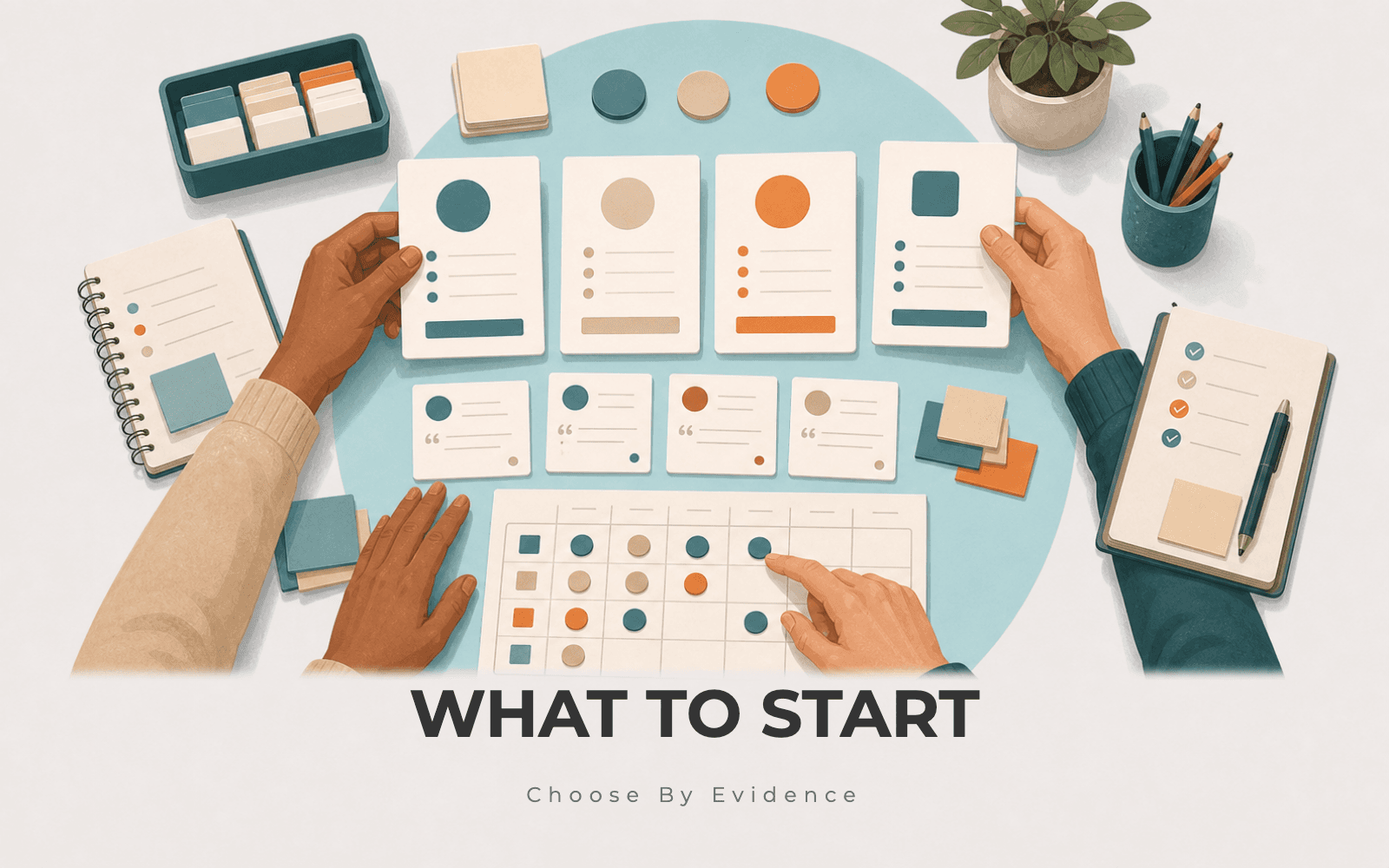
Score each idea from one to five across five filters: customer reach, pain strength, founder advantage, validation speed, and repeatability. Do not use the score as fake math. Use it to expose weak assumptions.
An idea with a smaller market but reachable customers can be a better first move than an impressive market where you cannot get a conversation. A service with manual delivery can be a better starting point than software if the problem is still unclear.
After scoring, choose one idea for a short validation sprint. The framework is meant to create action, not endless ranking.
Filter 1: Customer Reach
If you cannot find the customer, you cannot validate the business. Reach is more practical than market size at the beginning.
This section is a gate, not a decoration. If the founder cannot complete it in plain language, the idea is probably still too vague for product, marketing, or fundraising work. Slow down here and turn the point into an artifact the company can reuse: a note, checklist, customer definition, scorecard, outreach list, weekly review prompt, or decision memo.
The practical move: List where the customer already exists: directories, communities, marketplaces, local businesses, associations, newsletters, job posts, or your work history. Make it concrete enough that someone else could inspect the work and understand what changed. If AI helps draft, summarize, or compare options, use it as a speed layer, then review the output against customer facts and founder judgment.
The signal to watch: You can identify real prospects and start conversations within a week.
When that signal appears, write down what it means for the next task. The point is not to collect a nice insight. The point is to decide whether to continue, narrow, change, sell, build, or stop.
Avoid Choosing a customer because they sound valuable while having no route to them.. The common failure mode is treating this as a planning exercise instead of a market-facing loop. Every section should make the next customer conversation, offer, MVP, or operating decision sharper.
Filter 2: Pain Strength
A business needs a problem that creates urgency, cost, risk, wasted time, missed revenue, or emotional friction.
This section is a gate, not a decoration. If the founder cannot complete it in plain language, the idea is probably still too vague for product, marketing, or fundraising work. Slow down here and turn the point into an artifact the company can reuse: a note, checklist, customer definition, scorecard, outreach list, weekly review prompt, or decision memo.
The practical move: Write the last real moment when the pain occurs and what the customer does today to work around it. Make it concrete enough that someone else could inspect the work and understand what changed. If AI helps draft, summarize, or compare options, use it as a speed layer, then review the output against customer facts and founder judgment.
The signal to watch: Customers can describe recent examples without you explaining the problem for them.
When that signal appears, write down what it means for the next task. The point is not to collect a nice insight. The point is to decide whether to continue, narrow, change, sell, build, or stop.
Avoid Building around a mild annoyance that people complain about but never act on.. The common failure mode is treating this as a planning exercise instead of a market-facing loop. Every section should make the next customer conversation, offer, MVP, or operating decision sharper.
Filter 3: Founder Advantage
Advantage does not always mean years of experience. It can be access, taste, persistence, speed, domain exposure, or a beginner's fresh perspective.
This section is a gate, not a decoration. If the founder cannot complete it in plain language, the idea is probably still too vague for product, marketing, or fundraising work. Slow down here and turn the point into an artifact the company can reuse: a note, checklist, customer definition, scorecard, outreach list, weekly review prompt, or decision memo.
The practical move: Write down why you are unusually able to learn this market faster than another beginner. Make it concrete enough that someone else could inspect the work and understand what changed. If AI helps draft, summarize, or compare options, use it as a speed layer, then review the output against customer facts and founder judgment.
The signal to watch: You have a credible reason to keep going when the first test gets messy.
When that signal appears, write down what it means for the next task. The point is not to collect a nice insight. The point is to decide whether to continue, narrow, change, sell, build, or stop.
Avoid Confusing personal interest with customer insight.. The common failure mode is treating this as a planning exercise instead of a market-facing loop. Every section should make the next customer conversation, offer, MVP, or operating decision sharper.
Filter 4: Validation Speed
Some ideas require long build cycles before any customer signal appears. Those are risky for a first business.
This section is a gate, not a decoration. If the founder cannot complete it in plain language, the idea is probably still too vague for product, marketing, or fundraising work. Slow down here and turn the point into an artifact the company can reuse: a note, checklist, customer definition, scorecard, outreach list, weekly review prompt, or decision memo.
The practical move: Design a manual version, landing page test, paid sprint, spreadsheet MVP, or concierge offer. Make it concrete enough that someone else could inspect the work and understand what changed. If AI helps draft, summarize, or compare options, use it as a speed layer, then review the output against customer facts and founder judgment.
The signal to watch: You can get a meaningful yes, no, or correction within two weeks.
When that signal appears, write down what it means for the next task. The point is not to collect a nice insight. The point is to decide whether to continue, narrow, change, sell, build, or stop.
Avoid Using product complexity as an excuse to delay selling or interviewing.. The common failure mode is treating this as a planning exercise instead of a market-facing loop. Every section should make the next customer conversation, offer, MVP, or operating decision sharper.
Filter 5: Repeatability
A business is easier to improve when the problem, customer, delivery steps, and buying trigger repeat.
This section is a gate, not a decoration. If the founder cannot complete it in plain language, the idea is probably still too vague for product, marketing, or fundraising work. Slow down here and turn the point into an artifact the company can reuse: a note, checklist, customer definition, scorecard, outreach list, weekly review prompt, or decision memo.
The practical move: Ask whether the same offer could be sold to ten similar customers without rebuilding the whole promise. Make it concrete enough that someone else could inspect the work and understand what changed. If AI helps draft, summarize, or compare options, use it as a speed layer, then review the output against customer facts and founder judgment.
The signal to watch: The second customer needs a similar result, not a completely custom invention.
When that signal appears, write down what it means for the next task. The point is not to collect a nice insight. The point is to decide whether to continue, narrow, change, sell, build, or stop.
Avoid Starting with bespoke work that teaches little about a repeatable market.. The common failure mode is treating this as a planning exercise instead of a market-facing loop. Every section should make the next customer conversation, offer, MVP, or operating decision sharper.
Compare Service, Product, and Content Paths
Different business models test different risks. A service tests willingness to pay quickly. A product tests repeatable usage. Content tests attention and trust over time.
This section is a gate, not a decoration. If the founder cannot complete it in plain language, the idea is probably still too vague for product, marketing, or fundraising work. Slow down here and turn the point into an artifact the company can reuse: a note, checklist, customer definition, scorecard, outreach list, weekly review prompt, or decision memo.
The practical move: Choose the path that tests your riskiest assumption fastest. Many strong businesses start as a service, turn repeated delivery into a product, and use content to distribute the learning. Make it concrete enough that someone else could inspect the work and understand what changed. If AI helps draft, summarize, or compare options, use it as a speed layer, then review the output against customer facts and founder judgment.
The signal to watch: The model helps you learn, not just look like the kind of company you want later.
When that signal appears, write down what it means for the next task. The point is not to collect a nice insight. The point is to decide whether to continue, narrow, change, sell, build, or stop.
Avoid Choosing software because it sounds scalable before proving the workflow.. The common failure mode is treating this as a planning exercise instead of a market-facing loop. Every section should make the next customer conversation, offer, MVP, or operating decision sharper.
Run One Validation Sprint
A framework only matters if it changes behavior. Pick one business and test it.
This section is a gate, not a decoration. If the founder cannot complete it in plain language, the idea is probably still too vague for product, marketing, or fundraising work. Slow down here and turn the point into an artifact the company can reuse: a note, checklist, customer definition, scorecard, outreach list, weekly review prompt, or decision memo.
The practical move: Set a five-day sprint: define customer, interview, write offer, pitch, and deliver or revise. Make it concrete enough that someone else could inspect the work and understand what changed. If AI helps draft, summarize, or compare options, use it as a speed layer, then review the output against customer facts and founder judgment.
The signal to watch: By the end, you have customer quotes, objections, and at least one stronger or weaker reason to continue.
When that signal appears, write down what it means for the next task. The point is not to collect a nice insight. The point is to decide whether to continue, narrow, change, sell, build, or stop.
Avoid Keeping three ideas alive because choosing one feels uncomfortable.. The common failure mode is treating this as a planning exercise instead of a market-facing loop. Every section should make the next customer conversation, offer, MVP, or operating decision sharper.
The Right Business Is the One That Creates Evidence
You do not need to find the perfect business from your desk. You need to pick the business that creates the best evidence fastest.
If an idea scores well on reach, pain, advantage, validation speed, and repeatability, test it. If the market corrects you, adjust. That is progress.
100 Tasks AI exists for this kind of founder work: turn uncertainty into a next task, run the task, preserve the learning, and keep moving from idea toward a real company.

Martin Bell
Startup-building guidance from the 100 Tasks framework.